

AI case management uses machine learning, natural language processing, and agentic automation to cut paperwork, sharpen triage, and keep humans in the decision loop at every critical step. It is not a replacement for professional judgment. It is the infrastructure that makes judgment faster, more consistent, and fully auditable.
Three reasons this matters right now:
- Admin time drops. Pilot studies indexed on PubMed show ML-assisted workflows can reduce documentation burden and improve case identification accuracy, though results vary by setting and dataset.
- Risk surfaces earlier. Predictive models flag high-risk cases before they escalate, giving clinicians, caseworkers, and legal teams time to intervene.
- Decisions become auditable. Every routing choice, override, and status change is logged, which is non-negotiable in regulated environments.
Humans remain in control. The Case Management Society of America is explicit: technology should enable case managers to operate at the top of their license, not replace their judgment.
Key Takeaways
AI case management works when you combine the right technology with documented processes, human oversight, and a governance structure built before the first model goes live.
| Point | Details |
|---|---|
| Start with data readiness | Audit case data completeness and API connectivity before selecting any AI vendor or running a pilot. |
| Human-in-the-loop is non-negotiable | Design explicit human checkpoints and override logging into every AI-assisted workflow from day one. |
| Compliance is architectural | Immutable audit logs, role-based access, and encryption must be built in, not added after deployment. |
| Measure from a baseline | Establish 60-day pre-launch baselines for time-per-case, SLA compliance, and classification accuracy to prove ROI. |
| Modusiq as your process layer | Modusiq's living process documentation and audit trails give regulated teams the foundation AI automation requires. |
Table of Contents
- What actually counts as AI case management?
- Core capabilities and the technologies behind them
- Key benefits for your organization and your team
- How AI case management works across healthcare, legal, and human services
- A five-step roadmap for implementing AI case management
- Privacy, security, and U.S. compliance requirements you cannot skip
- Will AI replace your caseworkers? Governance and workforce reality
- Measuring success: KPIs and dashboard metrics that matter
- How to evaluate vendors and the questions to ask
- How Modusiq applies AI to case management
- What leaders should actually do in the next 90 days
- Modusiq gives you the process layer AI case management requires
- Sources
What actually counts as AI case management?
Intelligent case management is the application of AI and automation technologies to the full lifecycle of a case, from intake through closure. That lifecycle includes intake classification, triage, routing, document processing, SLA monitoring, and audit trail generation. The underlying technologies are machine learning models, natural language processing, robotic process automation, predictive analytics, and agentic orchestration layers that coordinate tasks across systems via APIs.
What it is not: a ticketing system that routes requests by keyword, a static workflow tool with no learning component, or a simple CRM with manual status fields. If there is no model making a classification or prediction, and no log that can be replayed for audit, it is not AI case management. The distinction matters when you are evaluating vendors. A comparison of case management versus ticketing systems shows where the boundary sits in practice.
Scope of what AI typically handles:
- Document ingestion, OCR, and structured data extraction
- Case classification and priority scoring
- Intelligent routing to the right team or individual
- Summarization of case history for handoffs
- SLA breach prediction and alerting
- Audit trail generation and immutable logging
- Agentic orchestration of multi-step case workflows across connected systems
Core capabilities and the technologies behind them
A useful way to think about this: capabilities are what the system does for your team; technologies are what makes those capabilities work. Here is a quick map of both.
Capabilities your team will use:
- Intake and classification: AI reads incoming cases, extracts key fields, and assigns a category and priority without manual data entry
- Intelligent routing: rules-based and ML-driven assignment sends cases to the right queue or person based on complexity, skill match, and workload
- Document understanding: NLP reads unstructured text in referrals, medical records, contracts, or field notes and pulls structured facts
- Summarization: large language models condense long case histories into a paragraph for handoff or review
- SLA tracking and alerting: the system monitors deadlines and surfaces breach risk before it happens
- Audit trails: every action, decision, and override is logged in an immutable record
- Agentic orchestration: multi-step workflows run automatically across connected systems, with human checkpoints built in
Short tech glossary:
- ML models: statistical models trained on historical case data to predict outcomes, classify inputs, or score risk
- NLP: natural language processing that reads and interprets free text in documents, notes, and messages
- RPA: robotic process automation that executes repetitive, rules-based steps across software interfaces
- Agentic automation: AI agents that plan and execute multi-step tasks, with deterministic rules exposed for audit and override
- API connectors: integration layers that link the case management platform to EHRs, CRMs, and data warehouses
- Explainability: the ability to show why a model made a specific decision, required for regulated use cases
- Immutable logs: write-once records that cannot be altered, essential for compliance audits
AWS documents how serverless and AI components can orchestrate case workflows while preserving human oversight at defined checkpoints, which is the integration pattern most regulated organizations should target.
Pro Tip: Before selecting a vendor, ask for a live demo of the audit trail. If the rep cannot show you a replayable, timestamped log of a specific case decision within two minutes, treat that as a red flag.
Key benefits for your organization and your team
The operational case for AI case management is straightforward, but the benefits land differently depending on who is measuring them.
- Time per case drops. Automated intake, classification, and summarization eliminate the manual steps that consume the most hours. Pilot evidence suggests meaningful reductions in documentation time under ML-assisted workflows.
- Backlogs shrink. Intelligent routing distributes work more evenly and flags stalled cases before they age out of SLA windows.
- Triage becomes consistent. A model applies the same criteria to every case, removing the variability that comes from staff experience, shift timing, or caseload pressure.
- Risk surfaces earlier. Predictive scoring identifies high-complexity or high-risk cases at intake, not after a crisis.
- Resource allocation improves. When you can see case volume, complexity distribution, and team capacity in one dashboard, staffing decisions get easier and cheaper.
- Compliance gets easier to demonstrate. Immutable audit logs and role-based access controls give compliance officers the evidence they need for audits without manual reconstruction.
CCM Certification's archived webinars show how data analytics tied to case management workflows translate into measurable population health outcomes, with concrete pilot measurement approaches that operations teams can adapt.
For compliance officers, the audit trail is the headline benefit. For operations leaders, it is throughput and SLA performance. For clinicians and caseworkers, it is time reclaimed from documentation and spent on clients.

How AI case management works across healthcare, legal, and human services
Healthcare
- Care coordination and discharge planning: AI reads EHR data, flags patients at risk of readmission, and surfaces care gaps before discharge. Coordinators receive a prioritized worklist instead of a raw patient census.
- Prior authorization: NLP extracts clinical criteria from referral documents and matches them against payer rules, reducing the manual review cycle from days to hours.
- Risk stratification: Predictive models score patient populations by acuity, enabling proactive outreach to high-risk members before an acute event.
Legal
- Intake triage: AI classifies incoming matters by practice area, urgency, and conflict risk, routing them to the right attorney or team without a paralegal manually reading every submission.
- Document review and deadline tracking: NLP reads contracts, filings, and correspondence to extract key dates, obligations, and clauses. Deadline alerts fire automatically, reducing malpractice exposure.
- Draft-first workflows: AI generates a first draft of standard documents (demand letters, status reports, intake summaries) for attorney review, cutting drafting time on routine matters.
Human services
- Eligibility triage: AI screens applications against program criteria and surfaces likely-eligible cases for caseworker review, reducing processing time for benefits determinations.
- Benefits casework: Automated reminders, document checklists, and status updates keep clients informed and reduce inbound calls to caseworkers.
- Field and office workflows: Mobile capture tools let field workers log notes, photos, and forms on-site. AI structures that input and syncs it to the central case record with a full audit trail.
A five-step roadmap for implementing AI case management
Getting from "we should do this" to a working pilot takes a structured sequence. Here is one that works in regulated environments.
-
Assess data readiness. Audit your existing case data for completeness, consistency, and accessibility. AI models are only as good as the data they train on. Identify gaps in structured fields, missing historical outcomes, and siloed systems that need API connectors before a model can see them.
-
Pick a pilot case type. Choose a high-volume, rules-friendly case type with clear outcomes and measurable cycle times. Avoid starting with your most complex or judgment-heavy cases. Systems-thinking principles applied to case workflows help you identify where process clarity already exists and where automation will land cleanly.
-
Design the human-in-the-loop workflow. Define exactly where AI makes a suggestion and where a human must confirm before action is taken. Document the override process, log every override, and set a review cadence for the first 90 days. Real-world pilots typically require an initial period where AI suggestions are logged but not auto-enforced, which reduces risk and builds operational confidence before scaling.
-
Measure and iterate. Track time-per-case, SLA compliance rate, classification accuracy, and override rate from day one. Set a baseline before go-live. Review weekly for the first month, then monthly. Adjust routing rules and model thresholds based on what the data shows.
-
Scale and govern. Once the pilot meets your success criteria, extend to adjacent case types. Establish a governance committee with authority to approve model updates, review bias reports, and manage change control for decision rules.
Pro Tip: Start with the case type your team finds most tedious, not the one that sounds most impressive in a vendor demo. High-volume, low-complexity cases build the operational muscle and the trust you need before tackling anything judgment-intensive.
Privacy, security, and U.S. compliance requirements you cannot skip
Compliance in AI case management is not a checkbox. It is an architectural decision. Build it in from the start or spend twice as much fixing it later.
Compliance checklist:
- HIPAA readiness: data processing agreements, minimum necessary data access, breach notification timelines under 60 days
- Role-based access controls: staff see only the cases and data fields their role requires
- Immutable audit logs: every action timestamped and write-protected, replayable for regulators
- Encryption at rest and in transit: AES-256 at rest, TLS 1.2 or higher in transit
- Data residency: confirm where data is stored and processed, especially for state-level health programs
- ISO 27001 alignment: information security management controls documented and auditable
Risk mitigation:
- Bias testing: run regular audits of model outputs across demographic groups to detect disparate impact
- Explainability: every AI-generated recommendation must be traceable to the inputs that drove it
- Minimal data collection: collect only what the model needs; do not store sensitive fields that are not used in decision logic
- Logging for reproducibility: maintain logs sufficient to replay any decision for an external audit
The WHO Bulletin's governance framework for digital health technologies makes the case for transparency and auditability as foundational design principles, not afterthoughts. That framing applies equally to legal and human services deployments.
On contracts: your data processing agreement with any AI vendor should specify breach notification timelines, data deletion schedules, sub-processor disclosure, and model update notification requirements. If a vendor cannot produce a DPA within 48 hours of request, that tells you something.
| Compliance area | What to verify |
|---|---|
| HIPAA | Signed BAA, minimum necessary access, breach notification SLA |
| Audit trails | Immutable, timestamped, replayable logs for every case action |
| Encryption | AES-256 at rest, TLS 1.2+ in transit |
| Bias and fairness | Documented testing methodology and review cadence |
| Data residency | Confirmed U.S. data center locations for regulated data |
Will AI replace your caseworkers? Governance and workforce reality
Short answer: no. Longer answer: the roles will change, and organizations that plan for that change will outperform those that do not.
Myth vs. fact:
- Myth: AI will automate caseworkers out of their jobs. Fact: AI automates the repetitive, document-heavy tasks (data entry, status updates, routing) so caseworkers spend more time on the judgment-intensive work that actually requires their expertise.
- Myth: AI decisions are black boxes that cannot be explained. Fact: Well-architected systems expose decision logic, log every step, and support human override at any point.
- Myth: Frontline staff will resist AI tools. Fact: Resistance usually comes from poor change management, not the technology itself. Staff who see their documentation burden drop become advocates quickly.
CMSA's practice guidance frames this well: technology should let case managers operate at the top of their license, handling the complex, relational, ethical dimensions of casework that no model can replicate.
Governance checklist:
- Model approval process with documented sign-off before any model goes to production
- Written SOPs for human overrides, including who can override, how it is logged, and when escalation is required
- Periodic bias and performance reviews on a defined schedule (quarterly minimum)
- Change control process for updates to decision rules or model thresholds
- User trust and adoption metrics tracked alongside operational KPIs
Pro Tip: Involve frontline caseworkers in pilot design from week one. Their knowledge of edge cases and workflow friction will improve the model faster than any retrospective feedback loop.
Measuring success: KPIs and dashboard metrics that matter
A pilot without a measurement plan is just an experiment with no conclusion. These are the metrics worth instrumenting.
Core KPIs:
- Time-to-triage: minutes from case creation to first classification and routing
- Time-per-case: total staff hours from intake to closure
- SLA compliance rate: percentage of cases resolved within the defined window
- Override rate: percentage of AI recommendations a human reverses (high override rates signal model drift or poor calibration)
- Classification accuracy: percentage of cases correctly categorized at intake
- Downstream outcome measures: readmission rates (healthcare), claim leakage (insurance), recidivism (human services)
Dashboard layout suggestion:
| Tile | Metric | Frequency |
|---|---|---|
| Operational | Time-per-case, active caseload, SLA compliance rate | Daily |
| Quality | Classification accuracy, override rate, escalation rate | Weekly |
| Compliance | Audit log completeness, access anomalies, bias review status | Monthly |
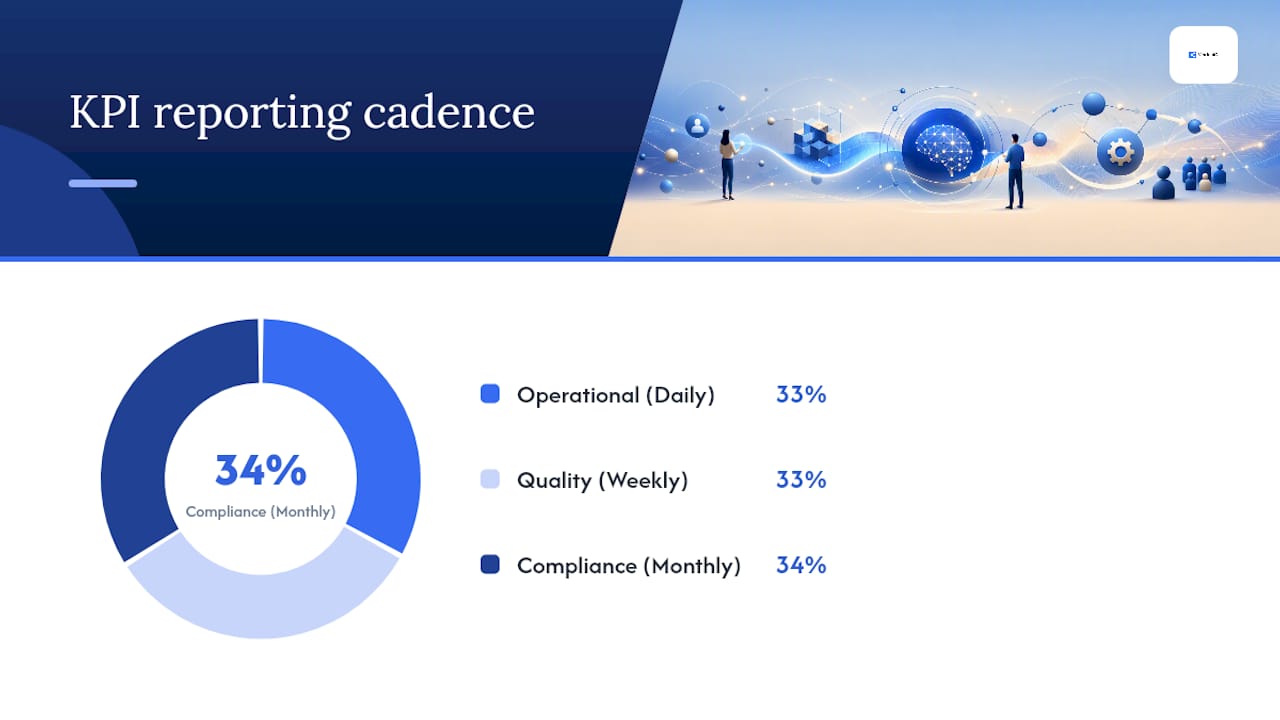
On attribution: establish a baseline period of at least 60 days before go-live. Where possible, run a phased rollout so you can compare AI-assisted and non-assisted cohorts directly. That comparison is what turns pilot data into a defensible ROI case for leadership.
How to evaluate vendors and the questions to ask
Most vendor demos look impressive. The procurement process is where you find out what is actually under the hood.
Vendor checklist:
- Open API connectors to your existing EHR, CRM, or data warehouse
- Immutable audit trails with export capability for regulators
- Explainability layer: can the system show why it made a specific recommendation?
- HIPAA compliance documentation and signed BAA availability
- ISO 27001 certification or equivalent information security controls
- Defined support SLAs with escalation paths
- Training and change-management support included in the contract
Procurement questions to ask in RFPs and demos:
- What is your data access model? Who owns the data, and what happens to it if we terminate the contract?
- How often are models updated, and how are we notified before a change goes live?
- Walk me through the human override mechanics. How is an override logged, and who can see it?
- Can you show us evidence from a pilot in our sector, including the baseline and post-implementation metrics?
- What is your breach notification timeline, and can we see your DPA template today?
Red flags:
- Claims of accuracy or ROI with no pilot data to support them
- Audit logs that are not replayable or exportable
- Vague answers about data ownership after contract termination
- No documented process for model updates or bias reviews
- A leaner operations-first architecture may serve you better than an enterprise platform with features you will never use
How Modusiq applies AI to case management
The problem Modusiq addresses is one most regulated organizations know well: SOPs scattered across shared drives, unclear ownership, and no way to prove during an audit that the right person followed the right process at the right time.
Modusiq's approach centers on living process documentation. Instead of static SOPs that go stale, Modusiq converts procedures into AI-powered, role-mapped workflows where every step has an owner, a deadline, and an audit trail. When a case moves through the system, the record shows exactly who did what, when, and in what sequence.
Key capabilities tied to the earlier capability map:
- AI-assisted process documentation that turns long SOPs into executable, assignable steps
- Role-based access and responsibility mapping so the right people see the right cases
- Immutable audit logs for every action, supporting HIPAA and ISO 27001 compliance postures
- Connectors and workflow automation that link case records to existing operational systems
- Compliance-ready architecture with GDPR and ISO 27001 alignment built into the platform design
For regulated organizations evaluating AI case management, Modusiq's free tier lets small teams or individual process owners start without a procurement cycle. Paid plans add organizational-scale compliance features, advanced usage controls, and dedicated support.
Pro Tip: Use Modusiq's process documentation layer before you automate anything. Clarity about who owns each step and what the decision criteria are is what makes automation reliable. Automating a poorly documented process just makes the mess run faster.
What leaders should actually do in the next 90 days
Most AI case management pilots fail for one of three reasons: the data was not ready, the pilot scope was too broad, or frontline staff were not involved until it was too late to change anything.
The conventional wisdom says to start with a proof of concept and scale from there. That is correct but incomplete. The part most guides skip is the governance work that has to happen before the first model runs in production. Without a documented override process, a bias review schedule, and a clear data ownership agreement, you are not running a pilot. You are running a liability.
Do this in the next 30 days: audit your case data for completeness, identify one high-volume case type with measurable cycle times, and get a signed data processing agreement from any vendor you are seriously evaluating. Do not let a vendor run on your data without one.
Do this in days 31–60: design the human-in-the-loop workflow on paper before touching any software. Define every checkpoint, every override path, and every escalation trigger. Involve at least two frontline caseworkers in that design session. Their edge cases will save you weeks of post-launch fixes.
Do this in days 61–90: run the pilot on a single case type, measure against your baseline, and hold a structured retrospective with the team. If staff satisfaction with the tool is low, find out why before you scale.
Avoid broad rollouts without pilots. Avoid black-box procurement where the vendor cannot explain the model. And never skip frontline training. The technology is rarely the failure point. The process around it almost always is.
Modusiq gives you the process layer AI case management requires
Regulated organizations that get AI case management right share one trait: they documented their processes before they automated them. Modusiq is built for exactly that starting point.
Modusiq converts scattered SOPs into living, role-mapped workflows with full audit trails, giving your team the process clarity that makes AI automation reliable rather than risky. Compliance posture for ISO 27001 and GDPR is built into the architecture, not bolted on later. Whether you are in healthcare, finance, or operations, you get a system where every case step has an owner, a record, and a path to audit.
Start with the free tier to document one process end-to-end, or explore the full process management system to see how living procedures, role mapping, and audit trails work together at organizational scale. Request a demo and bring your current SOP to the call.
Sources
- Automate case management workflows with Amazon Connect and AWS AI/ML
- NCBI / PubMed indexed study (PMID 32284647)
- Case Management Society of America (CMSA)
- Leveraging technology & data analytics to improve case management — CCM Certification archived webinars
This article is general information, not a substitute for advice from a qualified doctor. Consult a qualified healthcare professional about your own circumstances before acting on anything here.